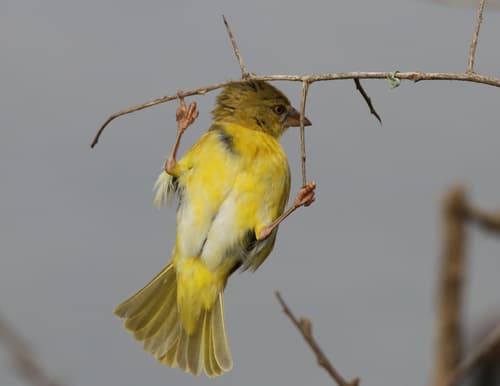
Village Weaver
NameVillage Weaver
Common NameVillage Weaver
Scientific NamePloceus cucullatus
FamilyPloceidae
Wingspan (cm)30
Length (cm)16
Weight (g)38
Plumage DetailsMales in breeding plumage have a black face, throat, and bill, with a chestnut nape and bright yellow underparts and crown. The back is streaked black and yellow. Females and non-breeding males (like the one pictured) are duller, with yellowish underparts, an olive-streaked back, and a yellowish-olive head. The bill is horn-colored.
Vocalization / CallVocalizations include a noisy, chattering 'chew-chew-chew' and a harsh 'zzzzzzzt' or 'tsik-tsik-tsik' often given in colonies. They also produce a variety of chirps and whistles.
Primary Dietomnivore
Primary Habitatssavanna, grassland, woodland, cultivated areas, urban parks
Conservation Statusleast-concern
Geographic RangeWidespread across sub-Saharan Africa, from Senegal and Mauritania east to Ethiopia and Somalia, and south to Angola, Zambia, and South Africa. Introduced to some Caribbean islands and parts of Europe.
Identifying Featuresstout conical bill, social nesting in colonies, elaborate woven nests, sexual dimorphism (breeding males bright yellow/black), non-breeding males and females yellowish with olive streaking
Description
The Village Weaver is a common and widespread passerine bird known for its elaborate woven nests. Males in breeding plumage are striking yellow and black, while females and non-breeding males are duller, often yellowish with olive-streaked backs. They are highly social birds, often found in large colonies.