Pectoral Sandpiper
NamePectoral Sandpiper
Common NamePectoral Sandpiper
Scientific NameCalidris melanotos
FamilyScolopacidae
Wingspan (cm)43
Length (cm)21
Weight (g)75
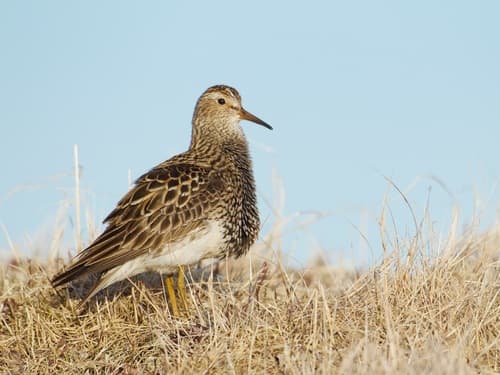
Plumage DetailsUpperparts are mottled brown with rufous tones and pale feather edgings, creating a scaly pattern. The breast is heavily streaked brown, forming a distinct bib that abruptly ends, contrasting with the pure white underparts. It has a pale supercilium, a dark line through the eye, and yellowish to olive legs.
Vocalization / CallIts typical call is a low, reedy 'krrrt' or 'churrrp', often given in flight. During breeding displays, males produce a distinctive hooting 'oo-ah' sound.
Primary Dietinsectivore
Primary Habitatstundra, wetland, grassland
Conservation Statusleast-concern
Geographic RangeBreeds across the Arctic tundra of North America and Siberia. It is a long-distance migrant, wintering primarily in southern South America, and also passing through parts of Asia and Australia.
Identifying FeaturesSharply demarcated streaked breast band, Yellowish to olive legs, Mottled brown upperparts with scaly appearance, Relatively long neck and short, slightly decurved bill
Description
The Pectoral Sandpiper is a medium-sized shorebird known for its distinctive sharply demarcated streaked breast band that contrasts with a clean white belly. It breeds in the Arctic tundra and undertakes long-distance migrations, often found in grassy wetlands during its journey.