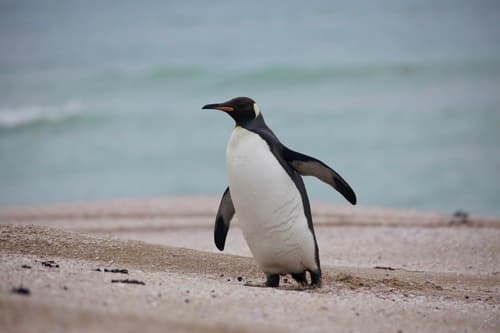
King Penguin
NameKing Penguin
Common NameKing Penguin
Scientific NameAptenodytes patagonicus
FamilySpheniscidae
Wingspan (cm)75
Length (cm)90
Weight (g)13650
Plumage DetailsAdults have a dark grey-black back, head, and flippers, contrasting with a bright white belly. They feature distinctive vivid orange-yellow patches on the sides of their head, extending to the upper chest, and a prominent orange-yellow teardrop-shaped patch on the lower mandible of the beak.
Vocalization / CallKing Penguins have a loud, trumpeting or braying call, often described as a series of resonant, guttural sounds. They use various calls for communication within the colony, including contact calls, alarm calls, and courtship displays.
Primary Dietpiscivore
Primary Habitatssubantarctic islands, coastal areas, open ocean
Conservation Statusleast-concern
Geographic RangeBreeds on subantarctic islands such as South Georgia, Falkland Islands, Crozet Islands, Kerguelen Islands, Heard Island, and Macquarie Island. Forages in the surrounding cold, nutrient-rich waters of the Southern Ocean.
Identifying Featureslarge size, orange-yellow ear patches, orange-yellow chest patch, long, slender black beak with orange-yellow lower mandible patch, dark grey-black back and white belly
Description
The King Penguin is a large, flightless seabird known for its striking orange-yellow patches on its head and chest. These highly social birds breed in dense colonies on subantarctic islands and are expert divers, foraging for fish and squid in deep ocean waters.