Horned Lark
NameHorned Lark
Common NameHorned Lark
Scientific NameEremophila alpestris
FamilyAlaudidae
Wingspan (cm)32
Length (cm)18
Weight (g)38
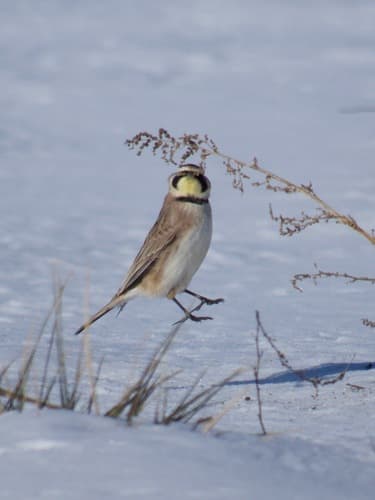
Plumage DetailsUpperparts are streaky brown, blending with the ground. Underparts are whitish to pale buff. The head features a striking pattern of yellow on the face and throat, a black mask extending from the bill to below the eye, and black 'horns' (feather tufts) on either side of the crown. The breast has a prominent black crescent.
Vocalization / CallTheir calls are typically high-pitched, tinkling, and often described as 'tseet' or 'tsee-tsee'. The song is a series of high-pitched, jumbled, tinkling notes, often delivered in flight during a circular display.
Primary Dietomnivore
Primary Habitatsdesert, grassland, mountain, tundra
Conservation Statusleast-concern
Geographic RangeWidely distributed across North America, Eurasia, and North Africa. In North America, it breeds from Alaska and northern Canada south through much of the United States and into central Mexico, with many populations being resident year-round.
Identifying Featuresyellow face and throat, black mask, black feather 'horns', black breast band, streaky brown back, ground-dwelling behavior
Description
The Horned Lark is a small, ground-dwelling songbird found in open, treeless environments. It is characterized by its streaky brown upperparts, pale underparts, and a distinctive facial pattern with yellow and black markings, including small feather tufts resembling 'horns'. These birds are often seen foraging on the ground, blending seamlessly with their barren or sparsely vegetated habitats.