Tooth-billed Hummingbird
NameTooth-billed Hummingbird
Common NameTooth-billed Hummingbird
Scientific NameAndrodon aequatorialis
FamilyTrochilidae
Wingspan (cm)11
Length (cm)13.5
Weight (g)7
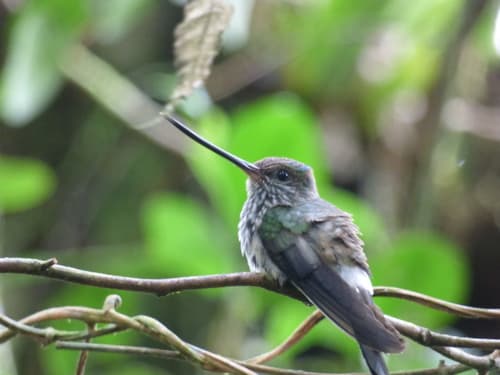
Plumage DetailsUpperparts are bronzy-green. Underparts are whitish with heavy green streaking on the throat and breast, becoming whiter on the belly. It has white undertail coverts and a small iridescent blue-green patch behind the eye. The bill is black.
Vocalization / CallVocalizations include high-pitched 'tsip' or 'tseet' notes, often given while foraging or in flight.
Primary Dietnectarivore
Primary Habitatsforest
Conservation Statusleast-concern
Geographic RangeFound in the humid montane forests of the western Andes, ranging from southwestern Colombia through Ecuador to extreme northern Peru.
Identifying FeaturesExtremely long, straight, and slender bill, Finely serrated bill (visible upon close inspection), Green upperparts, Heavily streaked white and green underparts, White undertail coverts
Description
This medium-sized hummingbird is easily recognized by its exceptionally long, straight, and finely serrated bill, which it uses to extract nectar from specific flowers. It typically perches quietly in the understory of humid montane forests, occasionally darting out to feed or catch insects.