Mourning Warbler
NameMourning Warbler
Common NameMourning Warbler
Scientific NameGeothlypis philadelphia
FamilyParulidae
Wingspan (cm)19
Length (cm)13.5
Weight (g)12
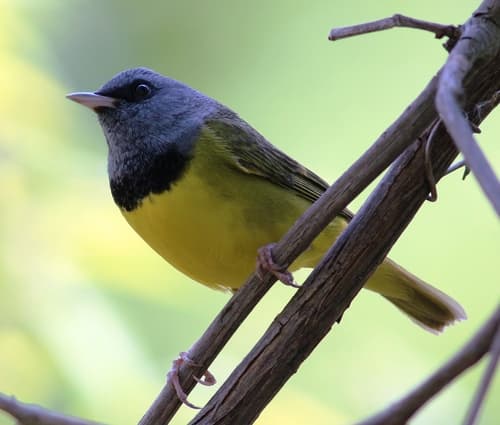
Plumage DetailsAdult males have a slate-gray head and neck, a distinctive black bib on the throat and upper breast, and bright yellow underparts. The back and wings are olive-green. Females and immature birds are duller, with a brownish-gray head, lacking the prominent black bib, and having paler yellow underparts.
Vocalization / CallThe song is a distinctive, rolling 'chirry, chirry, chirry, churro, churro' or 'teedle-teedle-teedle-tweedle-tweedle', often described as sounding like 'hurry, hurry, hurry, where are you?'. The call is a sharp 'chip'.
Primary Dietinsectivore
Primary Habitatsforest, wetland
Conservation Statusleast-concern
Geographic RangeBreeds across the boreal forests of Canada and the northeastern United States, typically in areas with dense undergrowth, regenerating clearcuts, and bogs. Winters in Central America and northern South America, from southern Mexico to Colombia and Venezuela.
Identifying FeaturesSlate-gray head and neck (male), Black bib on throat and upper breast (male), Bright yellow underparts, Olive-green back and wings, No eye-ring (distinguishes from similar species like MacGillivray's Warbler), Prefers dense undergrowth
Description
The Mourning Warbler is a small, active songbird known for its elusive nature, often staying hidden in dense undergrowth. Males display a striking gray head, black bib, and bright yellow underparts, while females are duller. They are primarily insectivorous, foraging low in vegetation.