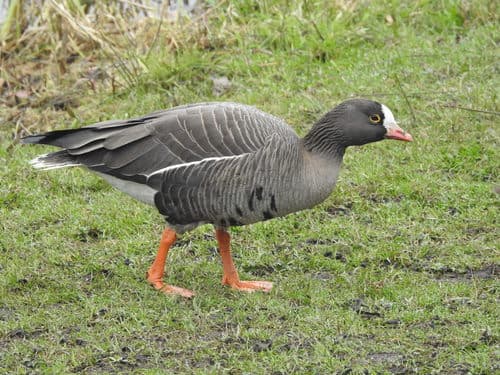
Lesser White-fronted Goose
NameLesser White-fronted Goose
Common NameLesser White-fronted Goose
Scientific NameAnser erythropus
FamilyAnatidae
Wingspan (cm)122.5
Length (cm)59.5
Weight (g)1850
Plumage DetailsAdults have dark grey-brown upperparts, paler grey underparts, and a white belly. A prominent white patch extends from the base of the pink bill (which has a dark base) over the forehead and slightly above the eye. A bright yellow eye-ring is a key feature. The legs are orange, and the flanks show fine white barring. Juveniles lack the white forehead patch and yellow eye-ring.
Vocalization / CallIts vocalizations are typically high-pitched, two-syllable calls, often described as 'kew-yew' or 'kyu-yu', which are more musical and higher-pitched than those of the Greater White-fronted Goose.
Primary Dietgranivore
Primary Habitatstundra, wetland, grassland
Conservation Statusendangered
Geographic RangeBreeds in the Arctic tundra and taiga zones of northern Scandinavia and Russia. It winters in scattered locations across southeastern Europe, the Caspian Sea region, and East Asia, including countries like Hungary, Greece, Turkey, Azerbaijan, Iran, and China.
Identifying FeaturesSmall size compared to other geese, Prominent white forehead patch (adults), Bright yellow eye-ring (adults), Pink bill with a dark base, Orange legs, Dark head and neck contrasting with paler body
Description
This small goose is characterized by its dark grey-brown plumage, a distinctive white forehead patch, and a bright yellow eye-ring. It is a migratory species, breeding in Arctic tundra and taiga and wintering in wetlands and grasslands, where it primarily grazes on vegetation.