King Eider
NameKing Eider
Common NameKing Eider
Scientific NameSomateria spectabilis
FamilyAnatidae
Wingspan (cm)94
Length (cm)60
Weight (g)1500
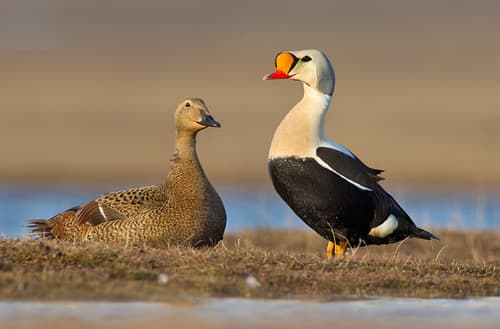
Plumage DetailsAdult males have a black body, white breast, and a pale grey-blue head with a prominent, large orange frontal lobe on the bill, bordered by black and green. They also feature a black V-shape on their back and white patches on the flanks. Females are uniformly mottled reddish-brown with fine barring, providing excellent camouflage, and have a smaller, dark bill.
Vocalization / CallMales produce a soft, cooing 'hoo-hoo-hooo' call, particularly during courtship displays. Females have a harsher, guttural 'karr-karr-karr' or 'guk-guk-guk' call, often given when disturbed or with young.
Primary Dietcarnivore
Primary Habitatsarctic tundra, coastal marine, open ocean
Conservation Statusleast-concern
Geographic RangeBreeds in the high Arctic regions of North America, Europe (Svalbard, Franz Josef Land), and Asia (Siberia). Winters in ice-free coastal waters further south, including the Bering Sea, North Atlantic, and occasionally the Great Lakes.
Identifying FeaturesMale: Large orange frontal lobe on bill, pale grey-blue head, black body, white breast, black V-shape on back, Female: Mottled reddish-brown plumage, dark bill, stocky body, less pronounced head shape, Both: Large, heavy-bodied sea duck, distinctive head shape (especially male), often seen in marine environments
Description
The King Eider is a large sea duck known for its striking sexual dimorphism, with males displaying vibrant plumage and a distinctive bill structure. These ducks are expert divers, foraging for marine invertebrates in the cold, ice-free waters of the Arctic and sub-Arctic regions. They are highly adapted to harsh northern environments, spending most of their lives at sea.