Great Horned Owl
NameGreat Horned Owl
Common NameGreat Horned Owl
Scientific NameBubo virginianus
FamilyStrigidae
Wingspan (cm)120
Length (cm)55
Weight (g)1400
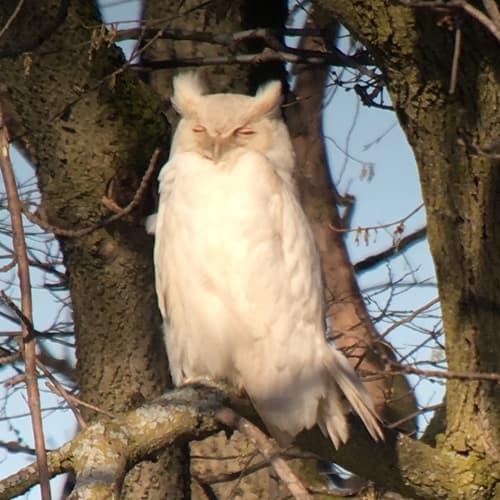
Plumage DetailsTypically, Great Horned Owls have mottled brown, gray, and white plumage with distinctive barring on the underside and a prominent white throat patch. However, the owl in the image exhibits leucism or albinism, characterized by an almost entirely white or very pale cream body, lacking the typical dark patterns and coloration, while still retaining its characteristic ear tufts.
Vocalization / CallA deep, resonant series of hoots, typically a five-note call described as 'hoo-hoo-hooo hoo-hoo'.
Primary Dietcarnivore
Primary Habitatsforest, woodland, grassland, desert, urban, suburban
Conservation Statusleast-concern
Geographic RangeWidespread across North and South America, from the Arctic tree line south through the United States, Mexico, Central America, and much of South America to Tierra del Fuego.
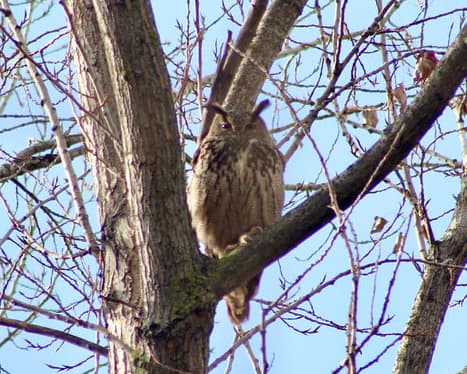
Identifying Featuresprominent ear tufts (horn-like), large size, deep hooting call, powerful build, yellow eyes (typically, though not visible in this image), white throat patch
Description
The Great Horned Owl is a large and powerful owl, easily recognized by its prominent ear tufts, often referred to as 'horns'. This highly adaptable nocturnal predator is found across a vast range of habitats, preying on a wide variety of animals. The individual in the image displays leucism or albinism, resulting in its unusually pale, almost white plumage.