Egyptian Plover
Image: <a rel="nofollow" class="external text" href="https://www.flickr.com/photos/50079771@N08">Steve Garvie</a> from Dunfermline, Fife, Scotland (CC BY-SA 2.0)
NameEgyptian Plover
Common NameEgyptian Plover
Scientific NamePluvianus aegyptius
FamilyPluvianidae
Wingspan (cm)47
Length (cm)20
Weight (g)80
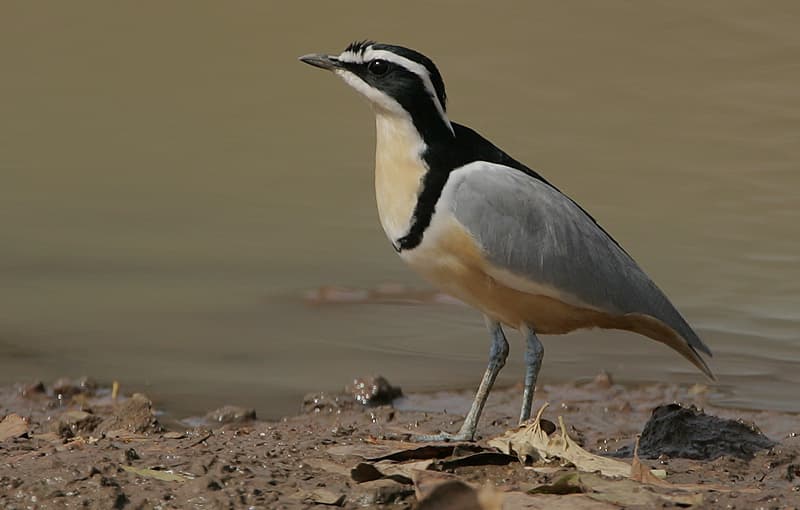
Plumage DetailsThe plumage features a black crown and eye-stripe, separated by a white supercilium. A broad black band extends from the nape down the back, meeting a black breast band. The back and wings are pale grey, while the underparts are a rich sandy-buff color. The bill is black and the legs are bluish-grey.
Vocalization / CallVocalizations include a high-pitched, piping 'kree-kree-kree' or 'wit-wit-wit' call, often given in flight or when disturbed.
Primary Dietinsectivore
Primary Habitatsriverbanks, sandbanks, mudflats, wetlands
Conservation Statusleast-concern
Geographic RangeFound across tropical sub-Saharan Africa, primarily along large rivers and lakes. It is particularly common in West Africa, including The Gambia.
Identifying FeaturesDistinctive black and white head pattern, Black breast band, Sandy-buff underparts, Pale grey back and wings, Long, slender bluish-grey legs, Black bill
Description
This striking wader is known for its distinctive black and white head pattern and sandy underparts. Often found on sandbanks and river edges, it is famously associated with crocodiles, though the 'crocodile bird' behavior of cleaning their teeth is largely anecdotal.