Black-tailed Trainbearer
NameBlack-tailed Trainbearer
Common NameBlack-tailed Trainbearer
Scientific NameLesbia victoriae
FamilyTrochilidae
Wingspan (cm)13.5
Length (cm)20
Weight (g)4.5
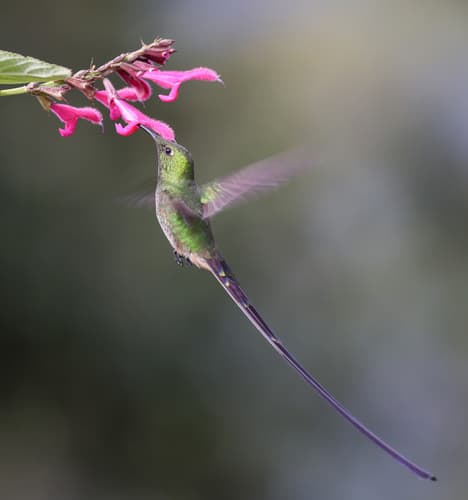
Plumage DetailsMales have brilliant iridescent green upperparts and flanks, with a white patch on the undertail coverts. The most striking feature is the very long, slender, black, slightly forked tail, which can be up to 17 cm long. Females are similar but have a much shorter tail and often less iridescent plumage. Both sexes have a straight, relatively short black bill.
Vocalization / CallVocalizations typically consist of high-pitched, thin 'tsip' notes given singly or in a rapid series. They may also produce soft trills or chattering sounds, characteristic of many hummingbird species.
Primary Dietomnivore
Primary Habitatsmountain, forest, grassland, urban
Conservation Statusleast-concern
Geographic RangeFound in the Andes mountains of South America, specifically ranging from Colombia through Ecuador to northern Peru. It inhabits high-altitude open shrubland, forest edges, gardens, and paramo.
Identifying FeaturesExtremely long, slender, black tail (especially males), Iridescent green body plumage, Straight black bill, Hovering flight pattern, White undertail coverts
Description
The Black-tailed Trainbearer is a medium-sized hummingbird known for its exceptionally long, slender, black tail, especially prominent in males. It exhibits iridescent green plumage and feeds primarily on nectar while hovering, often supplemented by small insects. This species is a common sight in the high-altitude Andean regions.