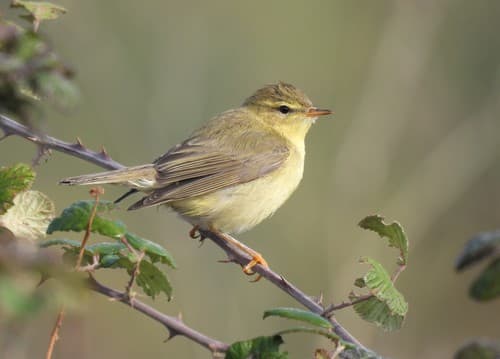
Willow Warbler
NameWillow Warbler
Common NameWillow Warbler
Scientific NamePhylloscopus trochilus
FamilyPhylloscopidae
Wingspan (cm)18.5
Length (cm)11.5
Weight (g)9.9
Plumage DetailsUpperparts are olive-green, often with a brownish wash, contrasting with pale yellowish underparts that become whiter on the belly. It features a prominent pale yellowish supercilium (eyebrow stripe) and a dark eye-stripe. The legs are typically pale, ranging from yellowish-brown to pinkish-brown.
Vocalization / CallThe song is a distinctive, melodious, and melancholic series of liquid notes that typically descend in pitch and fade away, often described as 'hoo-weet hoo-weet hoo-weet-wee-wee-wee-wee-wee-wee-wee-woo'. The call is a soft, disyllabic 'hoo-eet' or 'huit'.
Primary Dietinsectivore
Primary Habitatsforest, urban
Conservation Statusleast-concern
Geographic RangeBreeds across most of Europe and northern Asia, from Ireland and Great Britain east to eastern Siberia. It is a long-distance migrant, wintering exclusively in sub-Saharan Africa.
Identifying FeaturesPale yellowish supercilium, Pale legs (yellowish-brown to pinkish-brown), Olive-green upperparts, Yellowish underparts, Distinctive descending song
Description
The Willow Warbler is a small, slender migratory songbird with olive-green upperparts and yellowish underparts. It is known for its distinctive pale supercilium and a beautiful, melancholic descending song, often found flitting through the foliage of trees and shrubs.