White-fronted Woodpecker
NameWhite-fronted Woodpecker
Common NameWhite-fronted Woodpecker
Scientific NameMelanerpes cactorum
FamilyPicidae
Wingspan (cm)37.5
Length (cm)22
Weight (g)60
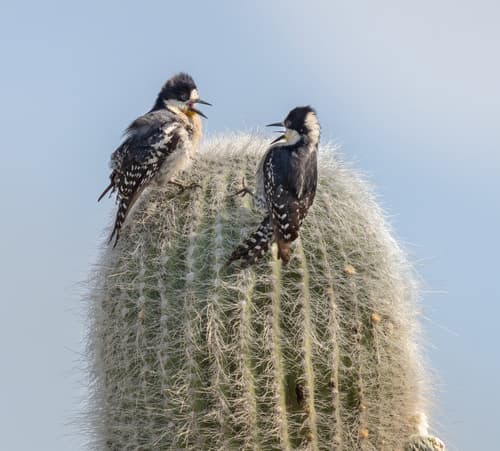
Plumage DetailsAdults have black upperparts with white barring on the back and wings, and a white rump. The underparts are whitish to pale yellow, sometimes with faint dark streaking on the flanks. The head features a white forehead, a black crown, a white supercilium, and a black stripe through the eye. A yellowish-orange patch is present on the nape, more prominent in males. The tail is black with white barring on the outer feathers.
Vocalization / CallVocalizations include a series of sharp, chattering notes, often described as 'kik-kik-kik' or 'churr-churr-churr'. They also produce typical woodpecker drumming sounds.
Primary Dietomnivore
Primary Habitatsdesert, forest, grassland
Conservation Statusleast-concern
Geographic RangeFound in South America, primarily in the Gran Chaco region, extending from Bolivia and Paraguay south into northern Argentina, and also in parts of southern Brazil.
Identifying FeaturesWhite forehead contrasting with black crown, Yellowish-orange nape patch, Black and white barred back and wings, Pale yellowish wash on underparts, Often associated with large cacti
Description
The White-fronted Woodpecker is a medium-sized woodpecker found in arid and semi-arid regions of South America. It is often seen foraging on cacti and trees, using its strong bill to extract insects and access fruits. These social birds are known for their striking black and white plumage with distinctive facial markings.