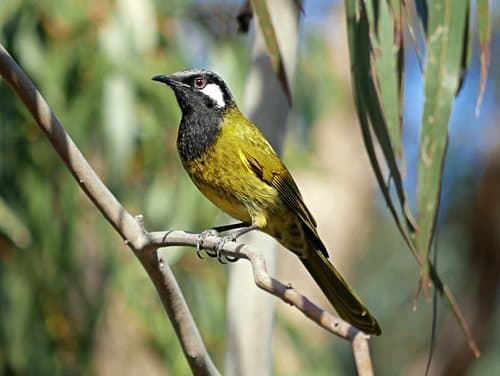
White-eared Honeyeater
NameWhite-eared Honeyeater
Common NameWhite-eared Honeyeater
Scientific NameLichenostomus leucotis
FamilyMeliphagidae
Wingspan (cm)25
Length (cm)20
Weight (g)25
Plumage DetailsAdults have a distinctive glossy black head and throat, contrasting sharply with a prominent white patch covering the ear coverts. The back, wings, and tail are olive-yellow, while the underparts are a duller olive-yellow, often with faint streaking. The eye is dark red, and the bill is black.
Vocalization / CallIts call is a loud, ringing 'chick-up' or 'chick-choo-wee', often repeated rapidly. It also produces a variety of softer chirps and chattering notes.
Primary Dietnectarivore
Primary Habitatsforest
Conservation Statusleast-concern
Geographic RangeEndemic to southeastern Australia, ranging from southeastern Queensland through New South Wales, Victoria, and into southeastern South Australia.
Identifying FeaturesGlossy black head and throat, Prominent white ear patch, Olive-yellow body plumage, Dark red eye, Black bill
Description
The White-eared Honeyeater is a medium-sized, active honeyeater known for its striking black head, prominent white ear patch, and olive-yellow body. It is typically found foraging in the canopy and understory of eucalypt forests and woodlands, feeding on nectar, insects, and sometimes honeydew.