Pied Honeyeater
NamePied Honeyeater
Common NamePied Honeyeater
Scientific NameCerthionyx variegatus
FamilyMeliphagidae
Wingspan (cm)25
Length (cm)17.5
Weight (g)20
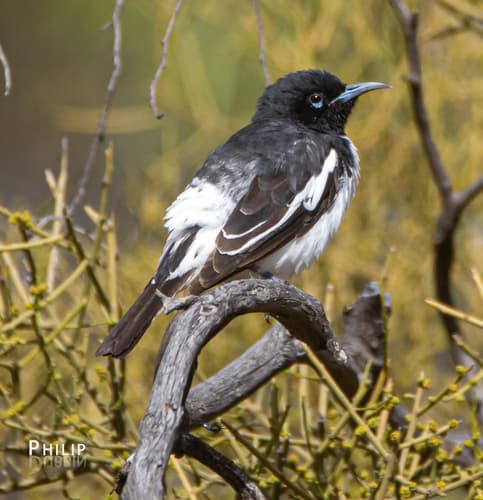
Plumage DetailsMales have a glossy black head, back, and upper breast, contrasting with a white lower breast, belly, and rump. Large white patches are prominent on the wings, especially visible in flight. Females are duller, with a streaked brown-grey back and whitish underparts. Both sexes feature a distinctive pale blue patch of bare skin around the eye and a slender, slightly downcurved, pale blue-grey bill.
Vocalization / CallKnown for a clear, piping whistle, often described as 'pee-pee-pee' or 'te-tew'. It also produces a harsh alarm call when disturbed.
Primary Dietomnivore
Primary Habitatsdesert, forest
Conservation Statusleast-concern
Geographic RangeWidespread across the arid and semi-arid inland regions of Australia, avoiding the extreme northern and south-eastern coastal areas. It is nomadic, moving in response to the availability of flowering plants.
Identifying FeaturesStriking black and white plumage (males), Distinctive pale blue bare skin around the eye, Slender, slightly downcurved, pale blue-grey bill, Prominent white wing patches, Piping whistle call
Description
The Pied Honeyeater is a medium-sized bird known for its striking black and white plumage, particularly in males. It is an active and nomadic species, often found in arid and semi-arid regions of Australia, where it feeds on nectar and insects. Its distinctive appearance includes a pale blue patch of bare skin around the eye.