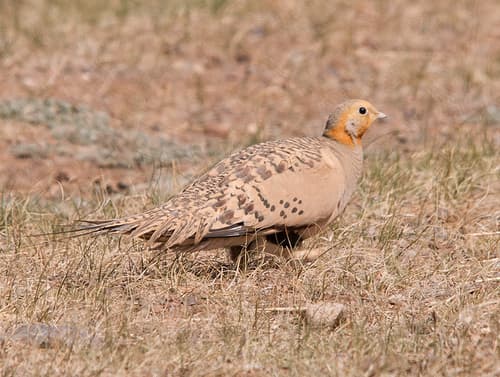
Pallas's Sandgrouse
NamePallas's Sandgrouse
Common NamePallas's Sandgrouse
Scientific NameSyrrhaptes paradoxus
FamilyPteroclidae
Wingspan (cm)65
Length (cm)35
Weight (g)250
Plumage DetailsMales exhibit a pale orange face and throat, a greyish breast band, and a prominent black belly patch. Their upperparts are sandy-buff with intricate dark barring and spots, providing excellent camouflage. Females and immatures are generally duller with more extensive barring across their plumage, lacking the distinct orange and black markings of the male. Their feet are fully feathered.
Vocalization / CallTheir vocalization is a distinctive, far-carrying 'kett-kett-kett' or 'chuck-chuck-chuck' call, often given while in flight or when approaching water.
Primary Dietgranivore
Primary Habitatsdesert, grassland
Conservation Statusleast-concern
Geographic RangeThe Pallas's Sandgrouse breeds across the steppes and semi-deserts of Central Asia, extending from the Caspian Sea eastward through Mongolia and northern China. While primarily resident, they are known for irruptive movements, occasionally appearing far west into Europe during severe winters or population booms.
Identifying FeaturesLong, pointed central tail feathers (streamers), Fully feathered feet, Cryptic sandy-buff plumage with dark markings, Orange face and throat (males), Black belly patch (males), Distinctive 'kett-kett' call
Description
The Pallas's Sandgrouse is a medium-sized, ground-dwelling bird known for its cryptic plumage that blends seamlessly with its arid habitat. It possesses distinctive long, pointed central tail feathers and uniquely feathered feet, adapted for walking on sand and cold ground. These birds are highly social and travel long distances in flocks to reach water sources.