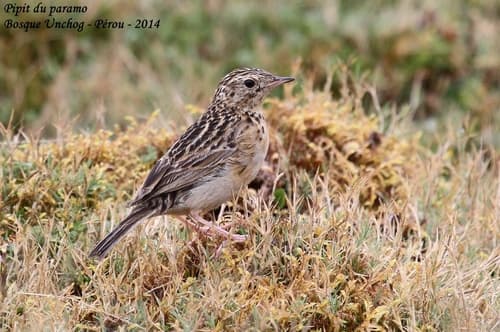
Páramo Pipit
NamePáramo Pipit
Common NamePáramo Pipit
Scientific NameAnthus bogotensis
FamilyMotacillidae
Wingspan (cm)21.5
Length (cm)15
Weight (g)18.5
Plumage DetailsUpperparts are heavily streaked with dark brown on a buffy-brown background, extending to the crown and nape. It features a pale supercilium above a dark eye-stripe. Underparts are buffy-white, with prominent dark brown streaking on the breast and flanks. The tail is dark brown with pale outer rectrices.
Vocalization / CallIts call is typically a thin, high-pitched 'tseep' or 'tsip', often given in flight. The song is a series of high-pitched, somewhat jumbled and repetitive notes.
Primary Dietinsectivore
Primary Habitatsgrassland, mountain
Conservation Statusleast-concern
Geographic RangeThe Páramo Pipit is endemic to the Andes Mountains of South America, ranging from Venezuela and Colombia south through Ecuador and Peru to Bolivia and northwestern Argentina. It exclusively inhabits high-elevation páramo and puna zones, typically above 3000 meters.
Identifying FeaturesHeavily streaked brown upperparts and breast, Pale supercilium, Terrestrial foraging behavior, Slender, pointed bill, High-altitude páramo habitat
Description
The Páramo Pipit is a small, streaky brown passerine found in high-altitude grasslands of the Andes. It is typically observed walking or running on the ground, foraging for insects among the tussock grasses and low vegetation. Its cryptic plumage provides excellent camouflage in its open, mountainous habitat.