Nordmann's Greenshank
NameNordmann's Greenshank
Common NameNordmann's Greenshank
Scientific NameTringa guttifer
FamilyScolopacidae
Wingspan (cm)57.5
Length (cm)30.5
Weight (g)175
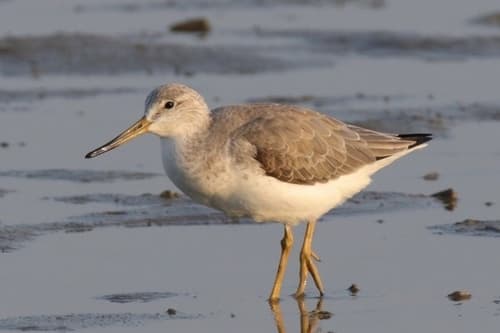
Plumage DetailsIn non-breeding plumage, it has pale grey-brown upperparts with faint streaking, a white belly, and a prominent white supercilium. The bill is long, slightly upturned, and bicolored with a dark tip and paler yellowish base. Legs are yellowish-green. Breeding plumage shows more distinct dark spotting and barring on the upperparts and breast.
Vocalization / CallIts vocalizations include a clear, whistling 'tew-tew' or 'twee-twee-twee' call, often given in flight or when disturbed.
Primary Dietcarnivore
Primary Habitatscoastal, wetland
Conservation Statusendangered
Geographic RangeBreeds in eastern Russia (Sakhalin Island, Kamchatka Peninsula, Khabarovsk Krai) and possibly northeastern China. Winters along the coasts of Southeast Asia, including Korea, Japan, China, Vietnam, Thailand, Malaysia, Singapore, Indonesia, and occasionally further south.
Identifying FeaturesLong, slightly upturned bicolored bill (dark tip, yellowish base), Yellowish-green legs, Pale grey-brown upperparts and white underparts in non-breeding plumage, Prominent white supercilium, Larger size compared to other greenshanks
Description
This large, pale-grey shorebird is typically found wading in shallow coastal waters, probing for food with its distinctive long, slightly upturned bill. It is a migratory species, breeding in eastern Russia and wintering across Southeast Asia.