Monteiro's Hornbill
NameMonteiro's Hornbill
Common NameMonteiro's Hornbill
Scientific NameTockus monteiri
FamilyBucerotidae
Wingspan (cm)55
Length (cm)56
Weight (g)350
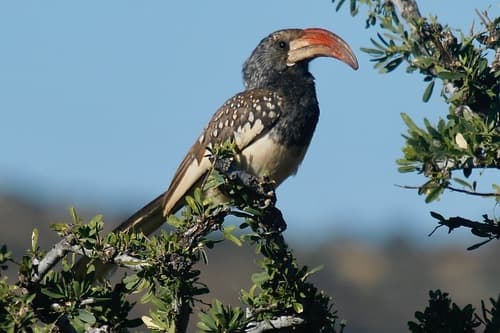
Plumage DetailsMales have a large, bright red bill with a creamy base to the lower mandible and a small casque, while females have a smaller, entirely red bill often with a black tip. Both sexes display dark brown to black upperparts heavily spotted with white, contrasting with pale creamy-white underparts. The tail is long and dark with white outer feathers.
Vocalization / CallKnown for a series of loud, accelerating 'tok-tok-tok' calls, often described as a clucking or cackling sound, which can be quite distinctive in its arid habitat.
Primary Dietinsectivore
Primary Habitatsdesert, grassland
Conservation Statusleast-concern
Geographic RangeEndemic to Angola and Namibia, primarily found in the arid and semi-arid regions, including rocky hillsides and dry woodlands.
Identifying FeaturesLarge, bright red bill (especially in males), Dark upperparts with prominent white spotting, Pale creamy-white underparts, Long tail with white outer feathers, Prefers arid and rocky habitats
Description
The Monteiro's Hornbill is a medium-sized hornbill characterized by its striking red bill and spotted plumage. It is an endemic species to the arid and semi-arid regions of southwestern Africa, where it forages primarily for insects on the ground and in low trees.