Hudsonian Godwit
NameHudsonian Godwit
Common NameHudsonian Godwit
Scientific NameLimosa haemastica
FamilyScolopacidae
Wingspan (cm)75
Length (cm)39.5
Weight (g)350
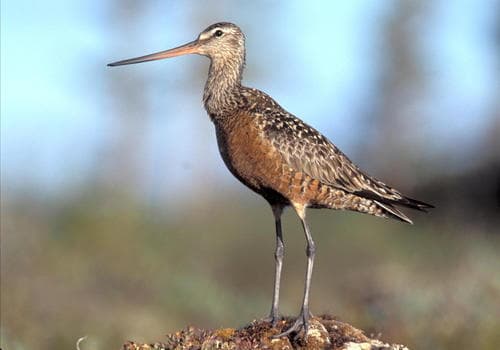
Plumage DetailsBreeding adults display a rich rufous-chestnut head, neck, and underparts, finely barred with dark brown on the flanks and belly. The back is mottled dark brown and buff. In flight, a prominent white wing stripe and a black tail with a white base are visible. Non-breeding birds are dull grayish-brown above and paler below, lacking the rufous coloration.
Vocalization / CallIts typical call is a nasal 'god-wit' or 'tew-wit', often repeated. During display flights, it may give a series of rapid, chattering notes.
Primary Dietinsectivore
Primary Habitatswetland, tundra, coastal, grassland
Conservation Statusleast-concern
Geographic RangeBreeds in arctic and subarctic regions of North America (Alaska and northern Canada) and southern South America (Tierra del Fuego). It undertakes long-distance migrations, with North American breeders wintering primarily in southern South America.
Identifying FeaturesLong, slightly upturned bill, Rich chestnut underparts in breeding plumage, Prominent white wing stripe in flight, Black tail with white base in flight, Long legs, Large size for a shorebird
Description
The Hudsonian Godwit is a large, long-legged shorebird characterized by its long, slightly upturned bill. It breeds in arctic and subarctic wetlands and undertakes one of the longest migratory journeys of any bird, traveling between the high Arctic and southern South America. Its striking chestnut breeding plumage makes it distinctive among shorebirds.