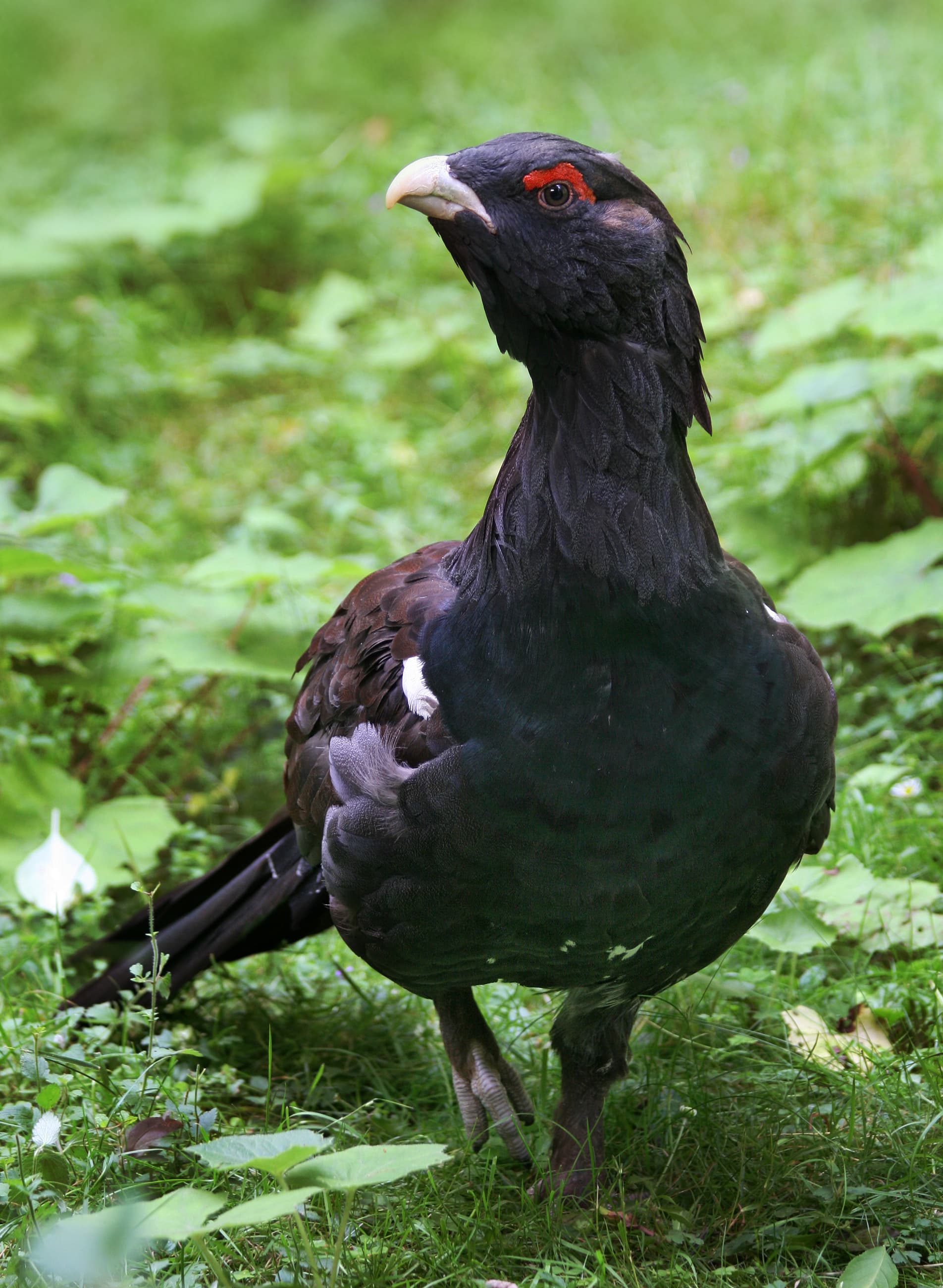
Capercaillie
Image: <a href="//commons.wikimedia.org/wiki/User:Richard_Bartz" title="User:Richard Bartz">Richard Bartz</a>, Munich aka <a href="//commons.wikimedia.org/wiki/User:Makro_Freak" title="User:Makro Freak">Makro Freak</a> <span class="mw-default-size" typeof="mw:File"><a href="//commons.wikimedia.org/wiki/File:Makro_Freak_bar.jpg" class="mw-file-description"><img src="https://upload.wikimedia.org/wikipedia/commons/8/8b/Makro_Freak_bar.jpg" decoding="async" width="80" height="15" class="mw-file-element" data-file-width="80" data-file-height="15"></a></span> (CC BY-SA 2.5)
Description
The Western Capercaillie is the largest member of the grouse family, known for its impressive size and elaborate mating displays. Males exhibit striking dark plumage with iridescent highlights and prominent red wattles, contrasting with the more camouflaged females. These forest-dwelling birds primarily feed on plant matter, especially conifer needles.